With the modern world experiencing unprecedented levels of stress, how can a trauma-informed approach to spiritual practice support us?
We recently met with Jo-ann Rosen founding member of EMBRACE (a trauma-informed sangha in the Plum Village tradition), guest on episode 92 of Plum Village podcast The Way Out Is In: ‘Trauma and Collective Healing’ and author of Unshakable: Trauma-Informed Mindfulness for Collective Awakening.
Adapting meditations from her book, Jo-ann and the EMBRACE sangha supported us to create the ‘Trauma Informed Practice’ folder – full of meditations and exercises to support a regulated nervous system.
Dear Jo-ann, thank you for joining us for this Plum Village App conversation – great to have some time with you. To start with, can you tell us – what is trauma-informed practice?
Trauma-informed practice is essentially looking through the lens of neuroscience and trauma-healing. It can really help us to understand the nervous system that we’re stuck with and all the dynamics at play as we interact with the world. We can then wisely individualise our practice. It can really put us in touch with the interbeing nature of everything that’s around us, the ways that our bodies respond to the world, the opportunity to see that we are absolutely not separate from it.
Could you also tell us about your own journey with this, and when you decided that it was something you wanted to explore more?
The first inkling that this was something I wanted to explore was when I took training in Community Resilience Model. During the training we were taught it’s OK to say you ‘shouldn’t focus on the breath’. I thought, ‘What do you mean? You shouldn’t focus on the breath?! That’s foundational to our Plum Village practice.’ And then we learned why – that, sometimes, there might be an adverse reaction to it. And, in fact, I realised I was having one. So I learned we must be cautious about introducing the breath as the only focus of our experience.
As I continued to explore, I read David Treleaven’s book, Trauma-Sensitive Mindfulness, and started to realise that there was a lot more to this breathing thing, this breathing, than I had imagined. Furthermore, I realised that the Anapanasati Sutra, translated as the “Full Awareness of Breathing Sutra”, really follows many of the current best practices in trauma healing, and that’s when I lit up!
I started looking more deeply at the ramifications of the nervous system that I’d inherited, and what I found was that, like having symptoms of an illness and then getting a diagnosis, I began thinking, ‘I can practice better from this because now I know what it is.’ And it was such a relief to not be ashamed or embarrassed or think there was something wrong with me.
The way I was functioning was perfectly human, and I could take advantage of that information to shed my shame, my guilt, and my fear of being found out as an imposter; to being curious and excited about how to work with my nervous system as a partner to my practice. My nervous system and my cognitive abilities were finally collaborating – which was tremendously exciting!
At this point, I started seeing everything through the eyes of neuroscience. I’m no expert, but it was enough to inspire what we’ve been developing.
With the awareness of our nervous system buoying us through difficulties, we must then learn to work as a collective, as an organism that can transcend the limits of any individual, to bring about collective change.
So helpful! Can you say more about Treleaven’s work and how it inspired you?
One of the basic principles that David Treleaven really uplifts is that the language should be ‘invitational’. So, if someone says, ‘Okay, breathe; now you’re going to feel relaxed’, and you don’t feel relaxed, then your nervous system might immediately go into threat mode. In turn, you are then present – however, the bigger picture is skewed; you’re hyper-focusing on the things that might be threatening. If, instead, someone says, ‘Take a long breath and notice what happens’, they can’t be wrong. Then you can be in that curious part of your brain, which is really mindful.
Thich Nhat Hanh wanted to give us confidence in the practice, so he said, ‘Do this and you’ll feel better right away.’ Well, with absolute respect for Thay, not everybody will feel better right away.
Treleaven has a whole episode about what makes apps trauma-sensitive and what makes them trauma-insensitive. And, interestingly, very, very few apps were trauma-sensitive. So I started looking more closely at the Plum Village App, and, well, that’s why I got in touch with you and the rest is history! I could see that EMBRACE had something important here to contribute to the app: to make sure it provided cautionary notes and alternative approaches to the guided-meditation section. This is where the ‘Trauma Informed Practice’ folder in the app evolved from.
I wonder who you feel the meditations in the ‘Trauma Informed Practice’ folder are for?
Well, they are for everyone. I had no idea, when I wrote the book (Unshakable: Trauma-Informed Mindfulness for Collective Awakening), who it was really for – until people started coming to me saying, ‘Oh, my goodness, this was so important for me, this really changed my perspective.’ From new practitioners to lay teachers and monastics.
I would say these practices are foundational. Not so much the particular meditations, although I think they’re valuable, but the notion of trauma-sensitive mindfulness itself. There seems to be a growing awareness that these practices are a good introduction to our Plum Village practice.
What key tips do you have for someone learning mindfulness and accessing practices via the app or elsewhere on the internet?
For one, assume that the guided meditation may not be just right for you at that moment, and that you need to notice your own reaction to the words and to change them to fit what you need. That’s not to say that we’re looking for comfort and bliss in every moment. It means that there may be assumptions within the guided meditation that don’t fit you. It’s not meant as a way to bypass discomfort, and that’s really important to understand, but people need to know their own capacity for discomfort in each moment. This way, they can choose wisely. Saying this, we’re not trying to shy away from what’s uncomfortable, and so not learn how to up our skill set, we’re just encouraging people to choose wisely.
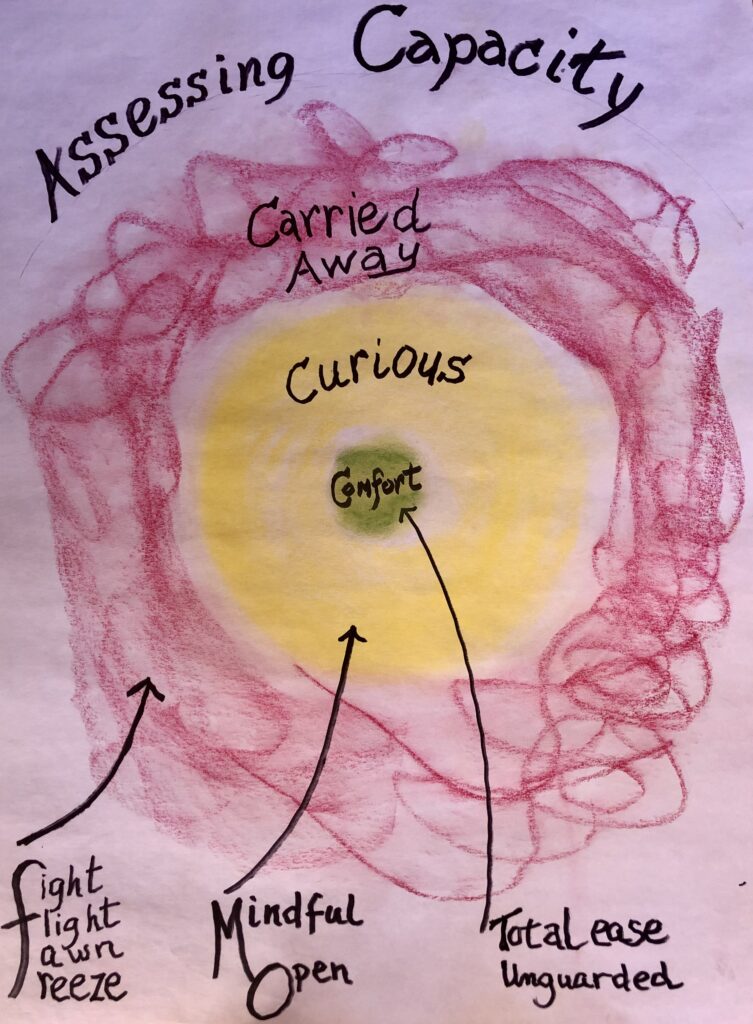
Picture by Jo-ann Rosen
Also, there are some pitfalls of practice that people really should know about in advance, so that, if they run into them, they know how to work with them. The first is when a practitioner avoids learning how to get along with people by staying silent and breathing, bypassing the need to develop good communication skills and trying to stay in a comfort zone all the time!
Secondly, there are some of us who go 200% into the practice, meditating several hours a day to fast-track ourselves to enlightenment. When this happens, you can disturb the brain chemistry’s natural balance.
Meditation affects the structure and the chemistry of our nervous system and our brain. And so there can be some very significant downsides, even if you have no severe history of mental health challenges. For instance, a focussed concentration can have adverse side-effects such as becoming dissociated from the body, or feelings, or becoming inflexible or indifferent. Too much of anything can have adverse effects.
We need to balance the cognitive and emotional/reactive parts of our brain to stay healthy, and practice is meant to maintain that balance in a healthy way.
One problem can be that we may gravitate to what we find success at, because we’ve already cultivated that quality or are naturally inclined to it. So if you are already trained in one pointed concentration, you’re already on your way, and you are already at some optimum balance – beyond which you may be overdoing it. Maybe what you need is some other, broader kinds of focus, like loving-kindness meditation, to keep your nervous system in balance.
Some great folks have studied the adverse effects of meditation. Willoughby Britton, who founded Cheetah House (Brown University in the United States), has a fabulous website full of different adverse conditions. Not everybody’s going to run across these, but with millions and millions of people playing around with meditation, without any guidance or without a sangha, it’s handy to know what you might encounter.
What would you recommend for anyone who experiences unsettling challenges in their mind/ body while attempting to practice mindfulness?
I would suggest that nobody practices without a sangha and, with online sanghas available, there’s no reason not to practice with a group, a sangha, a buddy, or to find a mentor to bounce off. In the Plum Village tradition, you should be able to find a mentor or a Dharma Teacher to talk to if you’re feeling reduced wellbeing after practicing.
To not practice in isolation, you could also consult a mental health professional or trusted healer. ‘More is better’ is not the way our nervous system functions best. Too much, too fast, can lead to dysregulation, and as we sink into deeper, unguarded meditation, memories may come up. They may not even seem like memories, because memories that are held in more trauma-like states are not experienced as a story. Traumatic memories automatically flip you into a survival mode, gearing you up for fight or flight – meaning that you may experience an immediate sense of fear or anger and be impulsively put into motion.
This can be very unsettling and scary. Try practice, ‘What Do You Do in an Emergency?’, and other resources on the EMBRACE website and the Plum Village App. See which are helpful, or notice what you’re naturally inclined to do as a result and whether these responses are soothing, or whether they have a negative effect that is harmful to yourself or others. What do those habitual reactions serve? What needs are being met? And see if there’s another strategy for meeting that need which doesn’t come with a big downside. When you calm yourself enough, reach out for support.
Some of these adverse side effects are gold mines if they’re excavated with a soft brush and not a shovel, and sometimes with help from other archeologists!
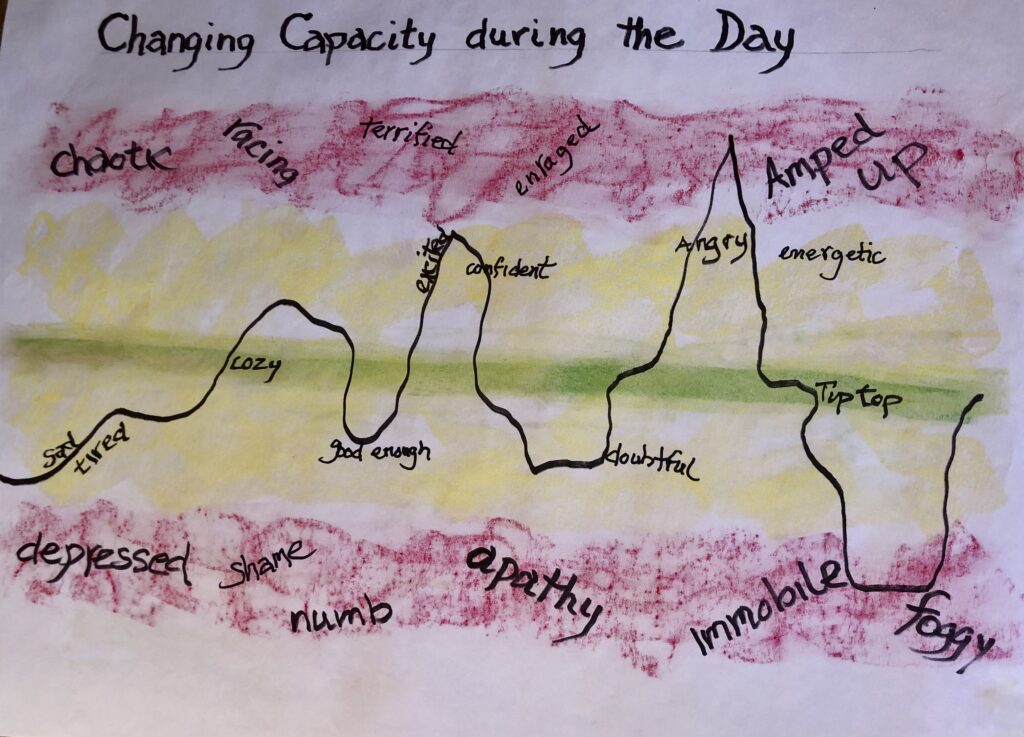
Picture by Jo-ann Rosen
I’m really conscious of how many people are increasingly asking AI chatbots for emotional help; can you speak about this mode of asking for support vs human contact?
That’s neurological, you know? You can get advice from an AI chatbot; and maybe its advice is good and maybe it’s made up. But when you’re with another human being, your nervous system regulation will automatically, physiologically respond to theirs – gathering up their sense of wellbeing, your body will begin to shift automatically with them. So it’s the relationship, in addition to the advice or the guidance, that’s vital – and you cannot get that from a chatbot.
But there’s another element that, in our individualistic world, goes under-recognised. Contemplative practice, spiritual journeying, is taken out of context when you enter the world of practicing with an app as your teacher. There is absolutely no substitute for humans traveling this road together in the flesh. When you practice, you should have guidance and eyes on your practice from a wise or experienced mentor and/or sangha. They see you in action in a way that you cannot see yourself. A working relationship comes naturally in the monastery, and fairly easily in an in-person sangha, even to a certain extent on a live online sangha – but doesn’t exist with a bot. Maybe you get a tip here or there from a bot, but a bot can’t accompany you, and it is not wisdom grown from lived experience.
Can you share with us where someone might find more information to support their practice in relation to taking care or learning about trauma?
EMBRACE Sangha offers an online in-person, eight-session study group twice a year: an embodied experience of these various tools. That’s one thing, and we’re constantly developing more.
The EMBRACE website also has an introductory workshop that you can watch. That gives you an easy dive into the basic ideas. We also have a monthly drop-in to give continued support to those who have taken the study group.
Again, I would also recommend David Treleaven’s book, because it has a therapy-oriented focus and is very thought-provoking.
And, lastly, there’s also a workbook coming out shortly to help sanghas create their own study group.
Thanks so much, Jo-ann! Is there anything else that you would like to share before we close?
When we accept the limitations of our humanness, and learn about neuroscience and trauma, and the fact that all human beings inherit trauma from the generations before and from the culture – we really zap ourselves with this hyper-focus on, ‘Oh, there’s something wrong with me. I’m not okay.’ It zaps our energy. Not only have we inherited this very limited nervous system, we’ve also inherited some of the mechanisms that can transcend our own nervous systems’ default – that’s very inspiring.
And when we’re not self-absorbed and in that black hole, then the practice becomes powerful. While practice teaches us as individuals how to become more clear, grounded, and stable, that itself is not an individual matter. Our vow in this lineage is to offer support to all beings, to alleviate suffering and find harmony, peace, and freedom. With the awareness of our nervous system buoying us through difficulties, we must then learn to work as a collective, as an organism that can transcend the limits of any individual, to bring about collective change. When we can feel ourselves as a part of such an organism, a whole world of connection opens up for us. This becomes a journey, a calling, and we travel together.
Resources:
‘Trauma-Informed Practice’ folder on the Plum Village App
EMBRACE Sangha (a trauma-informed sangha in the Plum Village tradition)
The Way Out Is In: Episode 92 ‘Trauma and Collective Healing’
Unshakable: Trauma-Informed Mindfulness for Collective Awakening – Jo-ann Rosen
Trauma-Sensitive Mindfulness – David Treleven
Cheetah House (Brown University in the United States) Cheetah House exists to provide evidence-based information and support to individuals who have experienced negative effects from meditation
☁️ As has been the case with Buddhist teachings for millennia, there is no charge for the Plum Village App and its digital content. However, if your means allow, please consider offering a donation to support our small team’s continued work on the app.
Dear Community,
Happy, smiling to know you are here.
Thank you Jo-Ann for caring and sharing.
Hearing your words is breathing new life into my body and mind.
According to my family tree.
I am 3rd generational victim of trauma along my maternal line.
I am victim of sexual abuse.
This type of trauma runs in the family too.
Horizontally and vertically.
I am breaking the cycle.
I am also 3rd generational victim of involuntary sectioning for mental health.
Again though my maternal line.
Only my grandmother was a victim of Electro Convulsive Therapy (ECT)
Following generations were treated with chemicals
Valium and prozac.
This is a type of trauma in itself.
I am no longer a victim
Thank you to the Plum Village practices.
And the Embrace Sangha.
I particularly enjoy the trauma informed meditations focusing on the homunculus.
I continue to reconcile the disharmony I experience with breathing/meditation
Practising deep relaxation
And a daily ‘metta’ practice of self love
I enjoy the loving kindness meditation towards myself
Looking deeply, I know the trauma my family and myself experienced lives on in me.
I practice with the Sangha as much as possible
A gentle and much needed reminder in this loud and chaotic world
I have everything I need to be healthy and safe
now and going forwards
what affects one of us, affects all of us
Interbeing
is the true nature of trauma.
Thanks, this was very interesting to read. It brought up a lot of questions for me. In the past I have been told by someone wise and experienced that my deepest questions were not welcome, so I mostly write in my journal instead of meditating now. I was told that my questions unenlighten other people. The wise and experienced person told me to do yoga instead of writing in my journal. I still like to read about mindfulness but I’ve stopped telling anyone my real questions.